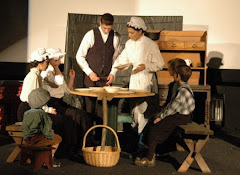
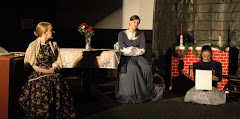
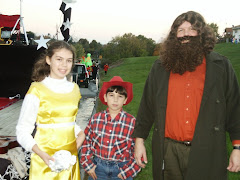
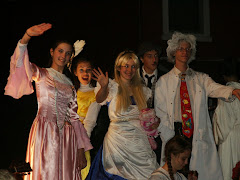
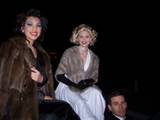
You were all so great the past two nights. Thank you so much for your hard work, dedication, teachable spirits and love. When we all work together we can do amazing things.
Please thank your parents for lending us for all these rehearsals and shows, and for driving you back and forth so much. Without their love and support none of us could have performed last night.
I also need to thank the wonderful crew we had this time around. Michael, Mrs. M, Mr. H, Jess, Mr. V, Mrs A and Mrs S. Thank you for all your help.
Lastly a big, big thank you to Bill and Barbara from the Strand for letting us use their building and helping us in soooo many ways. Show your appreciation by going to the other events at the Strand and telling your friends about them. You can check out their events at http://www.hamburgstrand.com
Now....what to do in the Spring? I have a few ideas but nothing firm so if you have a suggestion hit comment and let me know. Remember musicals are a bit out of our budget range just yet, but I'm saving up. : ) We have lots of strong female actresses in our company so keep that in mind too...not that we don't have strong actors too but we have lots of girls.
Well, I'm for a bit of a rest and regrouping. Keep in touch with each other and pop in here regularly to find out what's going on.
The Fine Arts Festival is coming.
Love,
Mrs. V
Showing posts with label Director's Notebook. Show all posts
Showing posts with label Director's Notebook. Show all posts
Friday, November 30, 2007

Thursday, November 15, 2007
That was a great rehearsal last night!
What a great rehearsal last night. I really saw things come together. Thanks so much for all your hard work. How did it feel to have some costumes and the set and props? Are you getting excited for the show? I know I can't wait.
I also want to thank everyone who made the costumes, set, and props possible. You have no idea how many angels are working in the wings for this show. We are blessed.
I'm sitting here this morning making a list of all the ways I am blessed by God. You guys are on that list. Make your own list of blessings. Then when hard times come, and unfortunately, they will, you will have your list to read and be encouraged by.
So, we have time off for Thanksgiving. Your assigment is to make that list of blessings. Put it in your favorite journal or a nice piece of paper and frame it to hang in your room. You'll know where to find it when you need to be reminded that God loves you immeasurably and will never stop loving you.
I'm going to ask about your lists at dress rehearsal.
Happy Thanksgiving!
Blessings,
Mrs. V
I also want to thank everyone who made the costumes, set, and props possible. You have no idea how many angels are working in the wings for this show. We are blessed.
I'm sitting here this morning making a list of all the ways I am blessed by God. You guys are on that list. Make your own list of blessings. Then when hard times come, and unfortunately, they will, you will have your list to read and be encouraged by.
So, we have time off for Thanksgiving. Your assigment is to make that list of blessings. Put it in your favorite journal or a nice piece of paper and frame it to hang in your room. You'll know where to find it when you need to be reminded that God loves you immeasurably and will never stop loving you.
I'm going to ask about your lists at dress rehearsal.
Happy Thanksgiving!
Blessings,
Mrs. V
Friday, November 2, 2007
Adopt a solider program
Hi Everyone,
Our family has adopted a soldier in Iraq and sends her letters and care packages. I thought it would be good for our theater company to adopt a soldier as well. His name is SPC Apollo Arevalo. If you are interested in learning more about him and sending him some notes of encouragement leave me a comment and I'll privately email you his address. Please pray for Apollo even if you can't send a letter.
Remember: The soldier’s first priority is war and not to be a pen-pal. They will respond if and when they can. You can be sure they are receiving what you send, but many do not have free time or any days off for extended periods of time. Service men and women tell us there is nothing like receiving something in the mail after coming back to their Iraqi base. Take heart knowing you have put a smile on their face that day…and they will remember you for years to come.
We can make a difference in so many lives and often very easily.
Blessings,
Mrs. V
Our family has adopted a soldier in Iraq and sends her letters and care packages. I thought it would be good for our theater company to adopt a soldier as well. His name is SPC Apollo Arevalo. If you are interested in learning more about him and sending him some notes of encouragement leave me a comment and I'll privately email you his address. Please pray for Apollo even if you can't send a letter.
Remember: The soldier’s first priority is war and not to be a pen-pal. They will respond if and when they can. You can be sure they are receiving what you send, but many do not have free time or any days off for extended periods of time. Service men and women tell us there is nothing like receiving something in the mail after coming back to their Iraqi base. Take heart knowing you have put a smile on their face that day…and they will remember you for years to come.
We can make a difference in so many lives and often very easily.
Blessings,
Mrs. V
Monday, August 20, 2007
Increase Your Theater Vocabulary
Here are some terms we will be using as we block and rehearse the play.
ACT1) Subdivision between sections of a play. A short play is a 'One-Act, a play with one interval has two Acts etc. Acts are subdivided further into Scenes.
ACTING AREA-That area within the performance space within which the actor may move in full view of the audience. Also known as the playing area This term is also used to describe the smaller subdivisions of the main stage area which are lit separately by the lighting designer (e.g. 'The stage is split into 6 acting areas, 3 downstage and 3 upstage'
AISLE - A passage through seating.
APRON - Section of the stage floor which projects towards or into the auditorium. In proscenium theatres, the part of the stage in front of the house tabs, or in front of the proscenium arch.
AUDITION - Process where the director or casting director of a production asks actors / actresses / performers to show him/her what they can do. Sometimes very nerve-wracking, but auditions can be a fairly painless process if handled properly. Performers are often asked to memorise a monologue from a play they like to perform for the director. Books full of suggested monologues are available. You may be asked to do a 'Cold Reading' which tests your own response to a piece of text you've not prepared.
AUDITORIUM - The part of the theatre accommodating the audience during the performance. Sometimes known as the 'house'. From the Latin Audio - 'I hear'.
BACKSTAGE - The part of the stage and theatre which is out of the sight of the audience. The service areas of the theatre.
BEGINNERS - A call given by Stage Management to bring those actors who appear in the first part of a play to the stage. e.g. 'Act One Beginners to the stage, please'. The actors/actresses are then called by name.A similar call is given after the interval
BLACK BOX - A kind of flexible studio theatre where the audience and actors are in the same room, surrounded by black tabs (curtains). Doesn't necessarily describe the audience layout, which can be easily reconfigured.
BLACKOUT / BO / B.O. - 1) Complete absence of stage lighting. Blue working lights backstage should remain on and are not usually under the control of the board, except during a Dead Blackout (DBO), when there is no onstage light. Exit signs and other emergency lighting must remain on at all times.2) The act of turning off (or fading out) stage lighting (e.g. 'This is where we go to blackout')
BLACKS - 1) Black clothing worn by stage management during productions. 2) Any black drapes or tabs, permanently or temporarily rigged. Used for masking technical areas.
BLOCKING - The process of arranging moves to be made by the actors during the play, recorded by stage management in the prompt script. Positions at the start of scenes are noted, as are all movements around the stage
BOX OFFICE - Part of the theatre front of house area where audience members can buy tickets. Most Box Offices are now computerised, and offer phone reservations. Some offer online (internet) bookings also.
BOX SET - Naturalistic setting of a complete room built from flats with only the side nearest the audience (the fourth wall) missing.
BREAK A LEG - A superstitious and widely accepted alternative to 'Good Luck' (which is considered bad luck).
CALL - 1) A notification of a working session (eg a Rehearsal Call) 2) The period of time to which the above call refers. (eg 'Your call for tomorrow nights show is 6.55pm') 3) A request for an actor to come to the stage because an entrance is imminent (these are courtesy calls and should not be relied on by actors 4) An acknowledgement of applause (eg Curtain Call)
CAST - The members of the acting company.
CASTING - The process of the director choosing actors to perform the characters in the play.
CENTRE LINE - Imaginary line running down the stage through the exact centre of the proscenium opening. Marked as CL on stage plans. Normally marked on the stage floor and used as a reference when marking out or assembling a set.Known in the US as CENTER LINE.See also SETTING LINE.
CLEARANCE - Message passed to Stage Management from the Front of House Manager that the house is ready for the performance to begin. (ie everyone is in their correct seat and there are no coach parties coming through the doors). Announced as 'We have Front of House Clearance'.
COMPANY - The cast, crew and other staff associated with a show.
COSTUMES - Clothes worn by the actors onstage. The responsibility of the WARDROBE DEPARTMENT.
CUE - 1) The command given to technical departments to carry out a particular operation. 2) Any signal (spoken line, action or count) that indicates another action should follow
CURTAIN CALL - At the end of a performance, the acknowledgement of applause by actors - the bows.
DIALOGUE - The spoken text of a play - conversations between characters is dialogue.
DIRECTOR - There are many types of director. Broadly, the role involves being responsible for the overall artistic vision of a production. ARTISTIC DIRECTOR - Normally in charge of the programming of a venue. May also direct shows. EXECUTIVE DIRECTOR - Manager in charge of the administration of a venue. TECHNICAL DIRECTOR - In charge of the technical requirements of a production. (The term LIGHTING DIRECTOR is used in the UK for a TV Lighting Designer).
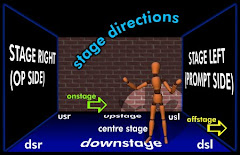
DOWNSTAGE - 1) The part of the stage nearest to the audience (the lowest part of a raked stage). [See Diagram] 2) A movement towards the audience (in a proscenium theatre).
DRESS REHEARSAL - A full rehearsal, with all technical elements brought together. The performance as it will be 'on the night'.
DRESSING ROOMS - Rooms containing clothes rails and mirrors (often surrounded with lights) in which actors change into their costumes and apply make-up. Dressing Room doors have a list of the actors contained within.
FRONT OF HOUSE (FOH) - 1) Every part of the theatre in front of the proscenium arch. Includes foyer areas open to the general public.2) All lanterns which are on the audience side of the proscenium and are focussed towards the stage.The backstage areas of the theatre are known as Rear of House (ROH).
INTERMISSION - Break between sections of a performance. During a play, the interval is normally half way through a standard length performance (approx 1 hour each half) and is usually 15 or 20 minutes in duration.
MARKING OUT - Sticking tapes to the floor of the rehearsal space to indicate the groundplan of the scenery. Also for marking position of furniture etc. within a set.
MATINEE - Afternoon performance of a show.
OFFSTAGE - 1) A movement towards the nearest side of the stage from the centre. 2) The area out of sight of the audience
PRESET - 1) Anything in position before the beginning of a scene or act (eg Props placed on stage before the performance, lighting state on stage as the audience are entering.) 2) An independently controllable section of a manual lighting board which allows the setting up of a lighting state before it is needed. Each preset has a master fader which selects the maximum level of dimmers controlled by that preset.
PROFESSIONAL*Normally used for someone who's regularly paid for a particular job (as opposed to an amateur, who does it for fun). A professional attitude is essential when working in the theatre - this means you have to behave as if you were being paid. The theatre world is a very small community - if you behave badly or upset someone, it's highly likely you'll meet them again, and they will remember you!
PROPS(Properties) - Furnishings, set dressings, and all items large and small which cannot be classified as scenery, electrics or wardrobe. Props handled by actors are known as handprops, props which are kept in an actors costume are known as personal props.
PROSCENIUM ARCH - The opening in the wall which stands between stage and auditorium in some theatres; the picture frame through which the audience sees the play. The 'fourth wall'. Often shortened to Proscenium or Pros Arch.In some older theatres, the Proscenium Arch is ornate and painted to contrast with the surrounding walls, to really make it stand out. Nothing outside the Proscenium Arch was part of the show. However, as there are many different audience layouts now, many theatres (particularly multi-purpose studio theatres) have no Proscenium Arch at all, or it may not be decorated as such.
.
RUN - 1) A sequence of performances of the same production. (e.g. 'How long is the run of this show?' or 'This show runs for two weeks')2) A rehearsal of the whole show or a section of it (e.g.'This afternoon's rehearsal will be a run of Act II followed by notes'). Run-throughs early in the rehearsal schedule are sometimes known as STAGGERS as actors are unsure of their lines.
SET1) To prepare the stage for action. (verb) - e.g. 'Have you set the chairs for Act 1?'2) The complete stage setting for a scene or act. (noun) - e.g.'What's the set for the finale?' French: décors.
STAGE LEFT / RIGHTLeft/ Right as seen from the Actor's point of view on stage. (ie Stage Left is the right side of the stage when looking from the auditorium.)
STAND-BY / STANDBY - 1) A warning given to technical staff by stage management that a cue is imminent.
TECH1) Short for Technical Rehearsal. 2) A member of (amateur) crew ('I'm the lighting tech for this show')
TECHNICAL REHEARSALUsually the first time the show is rehearsed in the venue, with lighting, scenery and sound. Costumes are sometimes used where they may cause technical problems (eg Quick changes). Often a very lengthy process. Often abbreviated to the Tech. A
UPSTAGE1) The part of the stage furthest from the audience. 2) When an actor moves upstage of another and causes the victim to turn away from the audience he is 'upstaging'. Also, an actor drawing attention to himself away from the main action (by moving around, or over-reacting to onstage events) is upstaging.
VISUAL CUEA cue taken by a technician from the action on stage rather than being cued by the stage manager. Often abbreviated to 'Vis'.
WINGS1) The out of view areas to the sides of the acting area.2) Scenery standing where the acting area joins these technical areas.
ACT1) Subdivision between sections of a play. A short play is a 'One-Act, a play with one interval has two Acts etc. Acts are subdivided further into Scenes.
ACTING AREA-That area within the performance space within which the actor may move in full view of the audience. Also known as the playing area This term is also used to describe the smaller subdivisions of the main stage area which are lit separately by the lighting designer (e.g. 'The stage is split into 6 acting areas, 3 downstage and 3 upstage'
AISLE - A passage through seating.
APRON - Section of the stage floor which projects towards or into the auditorium. In proscenium theatres, the part of the stage in front of the house tabs, or in front of the proscenium arch.
AUDITION - Process where the director or casting director of a production asks actors / actresses / performers to show him/her what they can do. Sometimes very nerve-wracking, but auditions can be a fairly painless process if handled properly. Performers are often asked to memorise a monologue from a play they like to perform for the director. Books full of suggested monologues are available. You may be asked to do a 'Cold Reading' which tests your own response to a piece of text you've not prepared.
AUDITORIUM - The part of the theatre accommodating the audience during the performance. Sometimes known as the 'house'. From the Latin Audio - 'I hear'.
BACKSTAGE - The part of the stage and theatre which is out of the sight of the audience. The service areas of the theatre.
BEGINNERS - A call given by Stage Management to bring those actors who appear in the first part of a play to the stage. e.g. 'Act One Beginners to the stage, please'. The actors/actresses are then called by name.A similar call is given after the interval
BLACK BOX - A kind of flexible studio theatre where the audience and actors are in the same room, surrounded by black tabs (curtains). Doesn't necessarily describe the audience layout, which can be easily reconfigured.
BLACKOUT / BO / B.O. - 1) Complete absence of stage lighting. Blue working lights backstage should remain on and are not usually under the control of the board, except during a Dead Blackout (DBO), when there is no onstage light. Exit signs and other emergency lighting must remain on at all times.2) The act of turning off (or fading out) stage lighting (e.g. 'This is where we go to blackout')
BLACKS - 1) Black clothing worn by stage management during productions. 2) Any black drapes or tabs, permanently or temporarily rigged. Used for masking technical areas.
BLOCKING - The process of arranging moves to be made by the actors during the play, recorded by stage management in the prompt script. Positions at the start of scenes are noted, as are all movements around the stage
BOX OFFICE - Part of the theatre front of house area where audience members can buy tickets. Most Box Offices are now computerised, and offer phone reservations. Some offer online (internet) bookings also.
BOX SET - Naturalistic setting of a complete room built from flats with only the side nearest the audience (the fourth wall) missing.
BREAK A LEG - A superstitious and widely accepted alternative to 'Good Luck' (which is considered bad luck).
CALL - 1) A notification of a working session (eg a Rehearsal Call) 2) The period of time to which the above call refers. (eg 'Your call for tomorrow nights show is 6.55pm') 3) A request for an actor to come to the stage because an entrance is imminent (these are courtesy calls and should not be relied on by actors 4) An acknowledgement of applause (eg Curtain Call)
CAST - The members of the acting company.
CASTING - The process of the director choosing actors to perform the characters in the play.
CENTRE LINE - Imaginary line running down the stage through the exact centre of the proscenium opening. Marked as CL on stage plans. Normally marked on the stage floor and used as a reference when marking out or assembling a set.Known in the US as CENTER LINE.See also SETTING LINE.
CLEARANCE - Message passed to Stage Management from the Front of House Manager that the house is ready for the performance to begin. (ie everyone is in their correct seat and there are no coach parties coming through the doors). Announced as 'We have Front of House Clearance'.
COMPANY - The cast, crew and other staff associated with a show.
COSTUMES - Clothes worn by the actors onstage. The responsibility of the WARDROBE DEPARTMENT.
CUE - 1) The command given to technical departments to carry out a particular operation. 2) Any signal (spoken line, action or count) that indicates another action should follow
CURTAIN CALL - At the end of a performance, the acknowledgement of applause by actors - the bows.
DIALOGUE - The spoken text of a play - conversations between characters is dialogue.
DIRECTOR - There are many types of director. Broadly, the role involves being responsible for the overall artistic vision of a production. ARTISTIC DIRECTOR - Normally in charge of the programming of a venue. May also direct shows. EXECUTIVE DIRECTOR - Manager in charge of the administration of a venue. TECHNICAL DIRECTOR - In charge of the technical requirements of a production. (The term LIGHTING DIRECTOR is used in the UK for a TV Lighting Designer).
DOWNSTAGE - 1) The part of the stage nearest to the audience (the lowest part of a raked stage). [See Diagram] 2) A movement towards the audience (in a proscenium theatre).
DRESS REHEARSAL - A full rehearsal, with all technical elements brought together. The performance as it will be 'on the night'.
DRESSING ROOMS - Rooms containing clothes rails and mirrors (often surrounded with lights) in which actors change into their costumes and apply make-up. Dressing Room doors have a list of the actors contained within.
FRONT OF HOUSE (FOH) - 1) Every part of the theatre in front of the proscenium arch. Includes foyer areas open to the general public.2) All lanterns which are on the audience side of the proscenium and are focussed towards the stage.The backstage areas of the theatre are known as Rear of House (ROH).
INTERMISSION - Break between sections of a performance. During a play, the interval is normally half way through a standard length performance (approx 1 hour each half) and is usually 15 or 20 minutes in duration.
MARKING OUT - Sticking tapes to the floor of the rehearsal space to indicate the groundplan of the scenery. Also for marking position of furniture etc. within a set.
MATINEE - Afternoon performance of a show.
OFFSTAGE - 1) A movement towards the nearest side of the stage from the centre. 2) The area out of sight of the audience
PRESET - 1) Anything in position before the beginning of a scene or act (eg Props placed on stage before the performance, lighting state on stage as the audience are entering.) 2) An independently controllable section of a manual lighting board which allows the setting up of a lighting state before it is needed. Each preset has a master fader which selects the maximum level of dimmers controlled by that preset.
PROFESSIONAL*Normally used for someone who's regularly paid for a particular job (as opposed to an amateur, who does it for fun). A professional attitude is essential when working in the theatre - this means you have to behave as if you were being paid. The theatre world is a very small community - if you behave badly or upset someone, it's highly likely you'll meet them again, and they will remember you!
PROPS(Properties) - Furnishings, set dressings, and all items large and small which cannot be classified as scenery, electrics or wardrobe. Props handled by actors are known as handprops, props which are kept in an actors costume are known as personal props.
PROSCENIUM ARCH - The opening in the wall which stands between stage and auditorium in some theatres; the picture frame through which the audience sees the play. The 'fourth wall'. Often shortened to Proscenium or Pros Arch.In some older theatres, the Proscenium Arch is ornate and painted to contrast with the surrounding walls, to really make it stand out. Nothing outside the Proscenium Arch was part of the show. However, as there are many different audience layouts now, many theatres (particularly multi-purpose studio theatres) have no Proscenium Arch at all, or it may not be decorated as such.
.
RUN - 1) A sequence of performances of the same production. (e.g. 'How long is the run of this show?' or 'This show runs for two weeks')2) A rehearsal of the whole show or a section of it (e.g.'This afternoon's rehearsal will be a run of Act II followed by notes'). Run-throughs early in the rehearsal schedule are sometimes known as STAGGERS as actors are unsure of their lines.
SET1) To prepare the stage for action. (verb) - e.g. 'Have you set the chairs for Act 1?'2) The complete stage setting for a scene or act. (noun) - e.g.'What's the set for the finale?' French: décors.
STAGE LEFT / RIGHTLeft/ Right as seen from the Actor's point of view on stage. (ie Stage Left is the right side of the stage when looking from the auditorium.)
STAND-BY / STANDBY - 1) A warning given to technical staff by stage management that a cue is imminent.
TECH1) Short for Technical Rehearsal. 2) A member of (amateur) crew ('I'm the lighting tech for this show')
TECHNICAL REHEARSALUsually the first time the show is rehearsed in the venue, with lighting, scenery and sound. Costumes are sometimes used where they may cause technical problems (eg Quick changes). Often a very lengthy process. Often abbreviated to the Tech. A
UPSTAGE1) The part of the stage furthest from the audience. 2) When an actor moves upstage of another and causes the victim to turn away from the audience he is 'upstaging'. Also, an actor drawing attention to himself away from the main action (by moving around, or over-reacting to onstage events) is upstaging.
VISUAL CUEA cue taken by a technician from the action on stage rather than being cued by the stage manager. Often abbreviated to 'Vis'.
WINGS1) The out of view areas to the sides of the acting area.2) Scenery standing where the acting area joins these technical areas.
Monday, August 13, 2007
In case you are wondering what part you would like.....
CLASSIC CHRISTMAS
CHARACTER LIST
BEST CHRISTMAS PAGEANT EVER
Narrator-tells the story from her viewpoint
Charlie – narrator’s brother
Alice – narrator’s friend, girl who always played Mary
Mother - a bit overwhelmed but determined
Father- supportive
Herdsmans:
Ralph –oldest, plays Joseph Imogene – plays Mary, most affected by story
Leroy, Claude, Ollie- brothers who play 3 wise men
Gladys – youngest and meanest – plays angel
Sunday school children – angels, shepherds, angel choir
CRATCHIT’S CHRISTMAS – FROM A CHRISTMAS CAROL
Ghost of Christmas Present – Narrator friendly, generous
Bob Cratchit-hardworking pleasant father A child at heart, Cratchit truly enjoys carrying Tiny Tim around town, and is a loving family man, loyal employee
Mrs. Cratchit-devoted wife, mother
Martha - oldest daughter - 18, lives away from home
Peter-oldest son, desires to be like father
Belinda-next daughter - 16, mother’s right arm
Jane- energetic daughter - 11
Alice – shy daughter - 10
Tiny Tim- a lame boy with a cheerful nature despite his ailments. youngest son.- 5
LITTLE WOMEN
Jo – 15 energetic & rebellious Meg – 16 ladylike older sister
Beth – 13 shy gentle, pianist Amy – 12, baby, artistic, self-centered
Marmee- ever patient, wise mother Mr. March-father, Union army chaplain
Hannah-housekeeper, Irish immigrant
GIFT OF THE MAGI
Della Pretty young woman, newly married and proud of her husband
Jim Husband of Della,.eager to provide the best for his wife
Mr. Crockerty-Jim’s boss
Madame Sofronie-owns the local hair-goods shop, chilly, hardly looked the 'Sofronie. Very blunt
CHARACTER LIST
BEST CHRISTMAS PAGEANT EVER
Narrator-tells the story from her viewpoint
Charlie – narrator’s brother
Alice – narrator’s friend, girl who always played Mary
Mother - a bit overwhelmed but determined
Father- supportive
Herdsmans:
Ralph –oldest, plays Joseph Imogene – plays Mary, most affected by story
Leroy, Claude, Ollie- brothers who play 3 wise men
Gladys – youngest and meanest – plays angel
Sunday school children – angels, shepherds, angel choir
CRATCHIT’S CHRISTMAS – FROM A CHRISTMAS CAROL
Ghost of Christmas Present – Narrator friendly, generous
Bob Cratchit-hardworking pleasant father A child at heart, Cratchit truly enjoys carrying Tiny Tim around town, and is a loving family man, loyal employee
Mrs. Cratchit-devoted wife, mother
Martha - oldest daughter - 18, lives away from home
Peter-oldest son, desires to be like father
Belinda-next daughter - 16, mother’s right arm
Jane- energetic daughter - 11
Alice – shy daughter - 10
Tiny Tim- a lame boy with a cheerful nature despite his ailments. youngest son.- 5
LITTLE WOMEN
Jo – 15 energetic & rebellious Meg – 16 ladylike older sister
Beth – 13 shy gentle, pianist Amy – 12, baby, artistic, self-centered
Marmee- ever patient, wise mother Mr. March-father, Union army chaplain
Hannah-housekeeper, Irish immigrant
GIFT OF THE MAGI
Della Pretty young woman, newly married and proud of her husband
Jim Husband of Della,.eager to provide the best for his wife
Mr. Crockerty-Jim’s boss
Madame Sofronie-owns the local hair-goods shop, chilly, hardly looked the 'Sofronie. Very blunt
Monday, July 2, 2007
Good article on writing and producing your own play
I found this article on-line about creating your own play and thought it might be interesting to all of you....
Q. So you want to put your own play on. How? You might have sent your precious play off to a theatre-or even several- and not had the response you want. Or maybe, you’re not writing the kind of stuff that’s easy to produce at the moment. Theatre is a fickle creature and she likes what she knows. But you don’t always have to compromise or put your script in a drawer; there is something you can do. Put your play on yourself. It’s not as daunting as it might seem with our friendly guide. We’ve all done it and lived to tell the tale. Here’s our advice.
To finish the article go to http://www.writewords.org.uk:80/articles/theatre1.asp
Q. So you want to put your own play on. How? You might have sent your precious play off to a theatre-or even several- and not had the response you want. Or maybe, you’re not writing the kind of stuff that’s easy to produce at the moment. Theatre is a fickle creature and she likes what she knows. But you don’t always have to compromise or put your script in a drawer; there is something you can do. Put your play on yourself. It’s not as daunting as it might seem with our friendly guide. We’ve all done it and lived to tell the tale. Here’s our advice.
To finish the article go to http://www.writewords.org.uk:80/articles/theatre1.asp
Friday, May 25, 2007
I just wanted to thank everyone who came out to auditions. You were all amazing and made my job casting the show really difficult. It’s exciting to see how much talent we have.
Here is the cast list for The Emporer’s New Clothes:
Cast List
Character Actor
Alena the Minstrel ----Allison B
Here is the cast list for The Emporer’s New Clothes:
Cast List
Character Actor
Alena the Minstrel ----Allison B
Emporer ----Joseph M
Dr. Smith ----Tyler P
Dr. Jones---- Derek M
Dr. Drivtonsils ----Connor K
Jeremy ----Jeff B
Dr. Smith ----Tyler P
Dr. Jones---- Derek M
Dr. Drivtonsils ----Connor K
Jeremy ----Jeff B
Trudy---- Danika G
Talula ----Brittney H
Desmona ----Kelia S
EsterHazie---- Elizabeth V
Lena ----Arica K
Empress -----Laura A
Sgt. Neener -----Ty S.
Miss Penelope Method---- Vanessa L
Cordelia Gleedrival----- Maddie A
Mr. Wart----- Nick V
Mr. Hog -----Geoffrey M
Very Old Woman -----Marissa L
Small Girl -----Samantha H
Mother -----Drew M
Serenada -----Maddie R
Mona Lisa ------Emmeline K
Donielle----- Danae M
Catalina------ Genevieve S
Owliva ------Natalie S
Townspeople------ Heather N. Alex V Madison R. Brandon N.
Talula ----Brittney H
Desmona ----Kelia S
EsterHazie---- Elizabeth V
Lena ----Arica K
Empress -----Laura A
Sgt. Neener -----Ty S.
Miss Penelope Method---- Vanessa L
Cordelia Gleedrival----- Maddie A
Mr. Wart----- Nick V
Mr. Hog -----Geoffrey M
Very Old Woman -----Marissa L
Small Girl -----Samantha H
Mother -----Drew M
Serenada -----Maddie R
Mona Lisa ------Emmeline K
Donielle----- Danae M
Catalina------ Genevieve S
Owliva ------Natalie S
Townspeople------ Heather N. Alex V Madison R. Brandon N.
Sarah V Cali S. Brittany S
Please feel free to contact me if you have any questions, conflicts or concerns.
Congratulations to a great cast!
Joyfully,
Mrs. V. and Mrs. Haag
Please feel free to contact me if you have any questions, conflicts or concerns.
Congratulations to a great cast!
Joyfully,
Mrs. V. and Mrs. Haag
Wednesday, April 18, 2007
Audition Notice
The Imaginatory Theater Company
Announcing
Announcing
Open Auditions for
The Emporer’s New Clothes
The Emporer’s New Clothes
Hamburg Strand Theater
6 South Fourth Street, Hamburg, PA 19526
Wed, May 23, 20074:00 – 7:00 p.m.
Wed, May 23, 20074:00 – 7:00 p.m.
Young people ages 12 – 17
No audition preparation required. Material will be taught at audition.
$5 audition fee and photo.
$5 audition fee and photo.
Show date June 20, 2007
For information contact Barb Vogelgesang 610-756-4194 or imaginatory@entermail.net
Subscribe to:
Posts (Atom)